You’ve decided you want to try stand-up paddleboarding. You’ve watched the videos of people gliding across calm water at sunrise, and you’re ready to find a board of your own. But the second you start shopping, the options hit you like a wave: hard boards versus inflatables, all-around versus touring, cheap boards versus expensive ones. It is overwhelming.
The overwhelming majority of newcomers choose an inflatable model because they are easier to store, cheaper to ship, and far less likely to get dinged up on the car roof. However, not all inflatables perform the same. Some are wobbly pool toys, and others are genuinely stable platforms that let you learn quickly. The true best inflatable paddle board for beginners balances stability, durability, and ease of use without requiring a massive budget. This guide breaks down exactly what to look for so you can make a confident first purchase and avoid expensive mistakes.
Key Takeaways
- Stability is the most critical feature for a beginner, driven primarily by board width, thickness, and volume.
- Buying from a reputable, service-oriented brand matters more than chasing the lowest price tag.
- Thicker, drop-stitch boards (at least 6 inches) will support higher weight limits and remain stiff for easier paddling.
- Accessories included in the package often determine the actual value of the purchase—especially the quality of the pump.
- Physical size and weight matter; beginners over 200 pounds need a higher-volume board to stay balanced and efficient.
Why Inflatable Boards Dominate the Beginner Market
Just a decade ago, inflatable paddle boards were considered flimsy compromises. That has changed completely. Modern inflatable boards use a process called drop-stitch construction, which allows them to be inflated to high pressure, resulting in a surface that is rigid enough to stand on comfortably.
For a beginner, the benefits are almost decisive. First, there is the storage factor. If you live in an apartment or have a car that is too small for an 11-foot solid board, an inflatable board rolls up into a backpack that fits in a closet. Second, inflatable boards are forgiving. They will not dent your car or chip if you bump them against a wall. They are significantly softer than fiberglass boards, so if you do fall onto the board itself, the impact is typically less painful.
The Accessory Factor
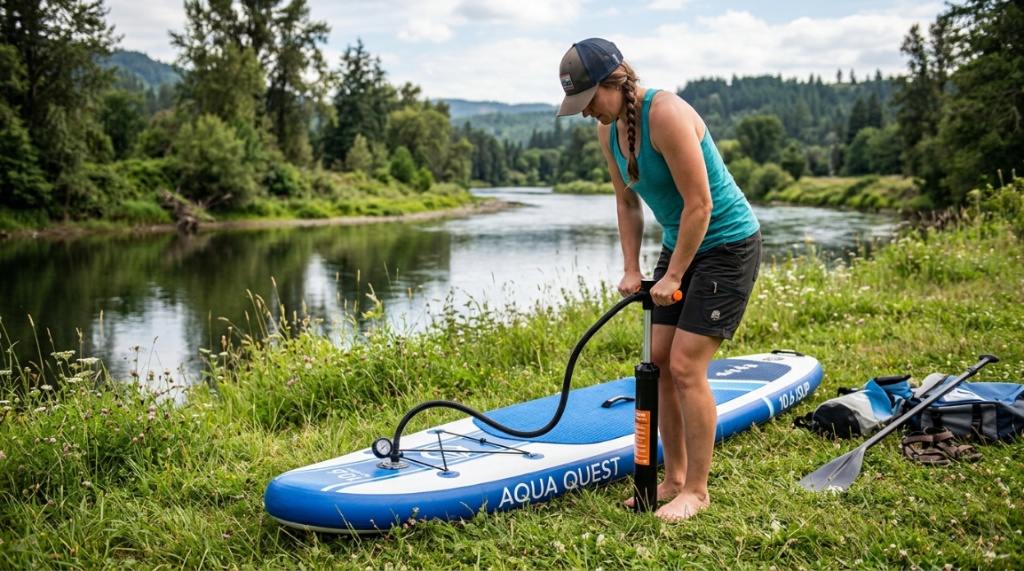
When looking for the best inflatable paddle board for beginners, you must consider what is in the box, not just the board itself. A beginner does not necessarily want to buy a pump, paddle, leash, and fin separately. Most high-quality packages include these, but the *quality* of the included pump is the real deciding factor. A cheap pump can take over 30 minutes to inflate a board properly. A dual-chamber, high-pressure hand pump can get you there in under 10 minutes.
Stability: The #1 Priority for New Paddlers
The most common mistake a new paddler makes is buying a board that is too narrow or too small because it looks faster or lighter. In paddling, speed looks like instability. For the vast majority of beginners, the goal is to stand up, balance, and paddle in a straight line without falling into the water every few minutes.
Stability boils down to three numbers:
- Width: Look for 32 to 34 inches. Any less than 32 inches will feel tippy for a novice.
- Thickness: Look for a minimum of 6 inches. This keeps the board rigid and prevents it from bending under your weight.
- Weight Limit: Check the manufacturer’s max capacity. If you weigh 200 pounds, a board rated for 220 pounds will sit low in the water and paddle sluggishly.
Volume and Weight Capacity
The volume, measured in liters, determines how much weight the board can support before it sinks deeper into the water. A board with higher volume will be more stable for heavier paddlers. Beginners often overlook this. If you have a board that is too small for your body weight, you will constantly feel like you are walking on a waterbed. You want the board to sit high in the water so your paddle can catch the water efficiently rather than scraping the side of the board with every stroke, Before heading out on your inaugural paddle session, make sure you protect your feet by choosing the right gear Pick Quick-Dry Swim Shoes for Lakes.
Board Shape and Design Differences
Not every inflatable board is shaped the same. “All-around” boards are the go-to for beginners, and for good reason. They feature a rounded nose and a wide tail, which helps them turn easily and stay balanced in flat water.
You should likely avoid “touring” boards for your very first purchase. These boards are longer and pointier, designed for speed and straight-line tracking over long distances. While they are faster, they are often narrower and require precise balance that you have not yet developed. It is better to master the basics on an all-around board first, then trade up to a touring board if you fall in love with distance paddling.
The iSUP Construction Quality
You want a board that is stiff. Manufacturers often advertise PSI (pounds per square inch) ratings. A board that only requires inflation to 12 PSI will feel like a floppy pool toy. The sweet spot for performance is around 15 to 20 PSI. You do not need a pressure gauge on the board itself, but you do need a pump with a gauge so you know exactly when to stop.
Look for “military-grade PVC” or “double-layer” construction. This simply means the shell of the board is tougher and resists punctures better. If you are paddling in lakes or rivers with rocky shores, this durability will save you from a frustrating tear that ruins your day—and potentially your board.
Weight and Portability Considerations
An inflatable board is lighter than a hard board, but it is not weightless. A typical full-size iSUP weighs anywhere from 18 to 30 pounds just for the board itself. When you add the rolled-up board, pump, paddle, and accessories, the backpack can easily weigh over 35 pounds.
If you are petite or have a bad back, this matters. You might want to look for a “lightweight” model, which trims weight by using lighter PVC and less material. These boards weigh in around 15 to 17 pounds and are easier to carry from the parking spot to the water’s edge. However, the trade-off is that extremely lightweight boards can sometimes flex more in the water unless they are reinforced with a carbon rail.
Fins: Built-In vs. Removable
Most boards come with a center fin and sometimes two smaller side fins. For beginners, a simple snap-in center fin is usually best. It is easy to attach and remove. Complicated “thruster” setups with three fins help with maneuverability, but they do not help a beginner who is just trying to feel the glide. A single larger fin will help you track straighter, which means fewer paddle strokes to correct your direction. That creates a more pleasant first experience.
The Learning Curve: What to Expect
It would help if you had reasonable expectations for your first session. Most people stand up on their first try, but they fall when they try to paddle. The technique is not just about balancing on the board; it is about balancing while using your core muscles to pull water. Your feet hurt because you are clenching the board with your toes. That is normal.
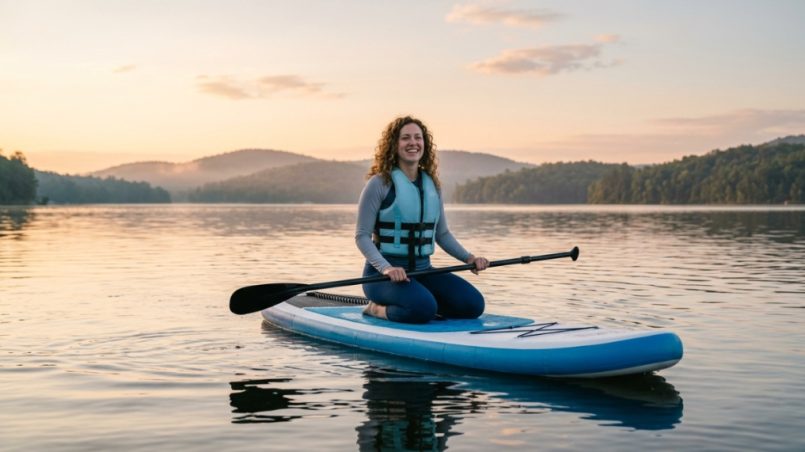
Beginners should learn to paddle from their knees first. Spend five minutes kneeling to get a feel for how the board moves. Then, stand up, keep your feet parallel and shoulder-width apart, and look at the horizon—not your feet. Looking down at your toes is the fastest way to topple over. Your board needs to be inflated to the correct pressure for this to work. A soft board will feel wobbly no matter how good your balance is.
Safety and Water Conditions
The best conditions for learning are flat water—a lake, a protected bay, or a slow-moving river. Avoid the ocean surf until you are comfortable. Always check the wind forecast. Even a light wind on an inflatable board is annoying because the board acts like a sail, catching the breeze and pushing you off course. If the wind kicks up, paddling against it is exhausting, and beginners often lack the stamina to get back to the launch point.
You should always attach the leash to your ankle. If you fall in, the leash stops the board from floating away. Because inflatables are lighter than hard boards, they are more prone to being blown across the water by the wind if you fall off and mistime your re-mount.
Budgeting for Your First iSUP
Price is the biggest temptation for beginners. Seeing an inflatable board for $250 is tempting versus a brand-name board for $600. But you are not necessarily paying for the logo when you spend more; you are paying for the manufacturing quality and the warranty.
- Under $300: Risky. Often single-layer PVC, low pressure rating, and poor accessories. These are usually marketed as toys rather than sports equipment.
- $400 to $600: The sweet spot for beginners. This range offers mass-market brands that deliver stable, durable boards with decent accessory packages.
- $700+: Professional or lightweight premium boards. Not strictly necessary for beginners unless you plan to travel with the board daily.
When you move past the “cheap” threshold, you also get better customer support. These manufacturers typically offer a 2-year warranty or even a 5-year warranty, which is critical. A budget no-name board might fail within the first season, and you will have no recourse. A reputable brand will help you troubleshoot and replace defective parts. In the long run, a reliable inflatable board will last several seasons, making it cheaper than buying a cheap one that needs replacing after ten uses.
Do You Need a Package Deal?
Many beginners purchase a “kit” that includes a board, a paddle, a leash, a pump, and a bag. This is a great way to save money. But you should pay attention to the specifics of the paddle, specifically whether it is aluminum or fiberglass. Aluminum paddles are heavy and usually included only on entry-level boards. Fiberglass paddles are lighter and more comfortable for a day on the water.
Similarly, examine the pump. A three-stage pump (high pressure) is necessary. A low-pressure pump used for rafts will not inflate your board to the required PSI; you will never get it stiff enough to stand on. Always set your pump to the board’s recommended PSI and start with all the air valves closed. Trying to pump with a valve open is the most common frustration for new owners.
Frequently Asked Questions
Is a hard paddle board better than an inflatable for a beginner?
Not necessarily. Hard boards are faster and stiffer, but they are fragile and require roof racks for transport. For most beginners, an inflatable board is better because it is safer to bang around, easier to store, and usually more stable due to their typically wider profiles.
How much does a decent beginner inflatable board cost?
Plan to spend between $400 and $600. This range provides the best combination of durable PVC construction, reliable accessory kits, and warranty support. Boards below $300 generally cut corners on thickness and material quality, which leads to poor performance.
Can a heavier person (over 220 lbs) ride a standard inflatable board?
You can, but you must check the weight limit. Look for boards classified as “XL” or “Touring” with a high volume (greater than 300 liters). You should also look specifically for boards that are 6 inches thick to ensure you do not feel the board flex or bend in the water.
How long does it take to inflate a paddle board?
With a good tri-action or dual-action manual pump, inflation takes roughly 7 to 10 minutes to reach 15 PSI. If you have an electric pump, the process takes slightly longer (about 9–12 minutes) but requires almost no physical effort.
What is the best water condition for a beginner?
Glass-smooth lakes or slow-moving rivers are ideal. “Glassy” water—water without a chop—is the easiest to balance on. Avoid choppy oceans or windy locations for your first few sessions, as the board will be pushed around by the waves and wind.
Conclusion
Choosing the right board does not need to be stressful. Focus your attention on the specifications over the paint job. A board with a width of at least 32 inches, a thickness of 6 inches, and a high pressure rating will serve you much better than a sleek-looking touring board that makes you wobble. Remember that the accessory kit matters: a good pump and a lightweight paddle are essential to getting on the water quickly and staying out longer.
Start in calm water, keep your damper smooth, and give yourself time to build confidence. Recognize that all beginners fall off—it is part of the learning process. With the right inflatable board, your progression from kneeling to standing to gliding will be a quick and enjoyable journey. Invest in quality, take care of your gear, and you will have a reliable watercraft that turns a simple lake outing into a full-body escape.