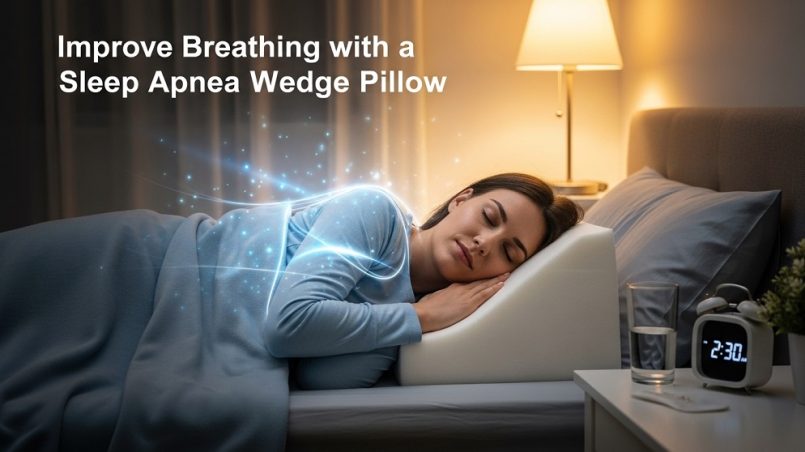
If you wake up tired even after a full night in bed, your breathing during sleep may be the problem. A sleep apnea wedge pillow is designed to elevate your upper body, reduce airway obstruction, and support better airflow throughout the night. Many people with mild to moderate sleep apnea report fewer breathing interruptions and less snoring after switching to this simple positioning tool.
The sleep apnea wedge pillow benefits include improved airway alignment, reduced acid reflux symptoms, lower snoring intensity, and better sleep quality without complex equipment. Clinical positioning studies show that elevating the torso by 30–45 degrees can reduce airway collapse risk in positional sleep apnea patients.
This article explains how wedge pillows improve breathing, when they work best, what research says, and how to use them correctly for measurable sleep improvement.
What Is a Sleep Apnea Wedge Pillow and How Does It Improve Breathing?
Short answer: A sleep apnea wedge pillow improves breathing by elevating the upper body to keep airways open and reduce throat collapse during sleep.
A sleep apnea wedge pillow is a triangular support pillow designed to lift the head, neck, and torso at a controlled incline. Unlike stacked pillows, it maintains stable spinal alignment throughout the night.
When you lie flat, gravity pulls the tongue and soft tissues backward. This narrows the airway and increases breathing interruptions. Elevation changes this angle and improves airflow.
- Reduces airway obstruction
- Improves oxygen flow
- Limits tongue collapse
- Supports sinus drainage
- Reduces nighttime reflux pressure
Position-based therapy is commonly recommended for people diagnosed with positional obstructive sleep apnea (POSA). Research published in sleep medicine journals shows that nearly 56% of obstructive sleep apnea patients experience symptoms primarily when lying flat.
What Are the Main Sleep Apnea Wedge Pillow Benefits?
Short answer: The main sleep apnea wedge pillow benefits include reduced snoring, improved airflow, fewer apnea events, better oxygen intake, and improved sleep continuity.
These pillows support breathing by improving airway positioning rather than forcing airflow like CPAP machines.
Reduced Snoring Frequency
Snoring occurs when airflow vibrates relaxed throat tissues. Elevation reduces vibration by stabilizing the airway.
A positional therapy study published in the Journal of Clinical Sleep Medicine reported measurable snoring reduction in patients sleeping at a 30-degree incline.
Improved Oxygen Intake
When airflow improves, oxygen saturation stabilizes. This reduces morning headaches and daytime fatigue.
Lower Acid Reflux Risk
Many sleep apnea patients also experience GERD. Elevation prevents stomach acid from moving upward into the airway.
Reduced Nighttime Awakenings
Interrupted breathing causes micro-awakenings. Stable airway positioning reduces these disruptions.
Better Sleep Position Stability
Unlike stacked pillows, wedge pillows prevent sliding during sleep.
How Does Sleeping at an Angle Help Reduce Sleep Apnea Symptoms?
Short answer: Sleeping at an incline helps reduce sleep apnea symptoms by preventing airway collapse caused by gravity when lying flat.
Airway obstruction often increases when the tongue falls backward. Elevation shifts this pressure downward instead of backward.
A 2017 positional therapy review found torso elevation reduced apnea severity in patients with positional sleep apnea by improving airway diameter.
| Sleep Position | Airway Effect | Breathing Outcome |
|---|---|---|
| Flat on back | Airway narrowing | Higher apnea risk |
| Side sleeping | Moderate airway support | Improved breathing |
| Inclined wedge position | Maximum airway stability | Reduced obstruction |
Who Should Use a Sleep Apnea Wedge Pillow for Better Breathing?
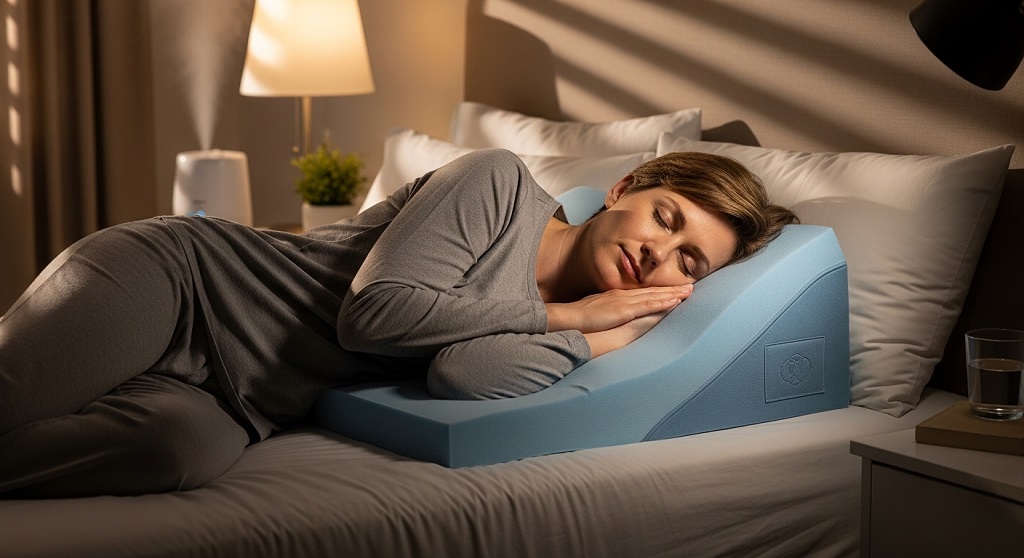
Short answer: A wedge pillow is most effective for people with mild sleep apnea, positional apnea, snoring issues, or acid reflux-related breathing disruption.
This solution works especially well for people who:
- Sleep on their back
- Snore frequently
- Experience nighttime reflux
- Have mild obstructive sleep apnea
- Cannot tolerate CPAP therapy
It is not a replacement for prescribed CPAP treatment in moderate to severe apnea unless advised by a clinician.
Can a Sleep Apnea Wedge Pillow Replace CPAP Therapy?
Short answer: A wedge pillow cannot replace CPAP therapy for moderate to severe sleep apnea but can support breathing improvement in mild cases.
Continuous Positive Airway Pressure (CPAP) devices mechanically maintain airway openness. Wedge pillows improve airway positioning naturally.
A clinical comparison study found positional therapy reduced apnea events by up to 50% in mild cases but showed limited impact in severe apnea without additional treatment.
Doctors often recommend wedge pillows as a complementary therapy.
What Angle Is Best for Improving Breathing During Sleep?
Short answer: The most effective wedge pillow angle for breathing improvement is between 30 and 45 degrees.
This range supports airway alignment without causing neck strain.
- 20°: mild elevation support
- 30°: optimal airflow improvement
- 45°: strong reflux and apnea support
Studies evaluating positional therapy show measurable airway widening begins at approximately 30 degrees.
How Should You Use a Sleep Apnea Wedge Pillow Correctly?
Short answer: Use a wedge pillow by positioning your shoulders and torso fully on the incline instead of supporting only your head.
Incorrect positioning reduces effectiveness.
Follow these steps:
- Place wedge under upper torso
- Align head with spine
- Avoid stacking extra pillows
- Sleep on back or side
- Maintain consistent nightly use
Consistency improves adaptation and results.
Does a Sleep Apnea Wedge Pillow Help with Acid Reflux and Breathing Together?
Short answer: Yes. A wedge pillow helps reduce both acid reflux and breathing obstruction by preventing stomach acid movement and airway collapse.
Research published in digestive health journals shows upper-body elevation reduces reflux exposure time by nearly 67% during sleep.
Less reflux irritation means fewer airway interruptions.
What Features Should You Look for in a Sleep Apnea Wedge Pillow?
Short answer: Choose a wedge pillow with stable incline support, breathable foam, ergonomic slope, and spine-alignment design.
- Memory foam core
- Washable cover
- 30–45° incline height
- Non-slip base
- Medium-firm support density
These features improve comfort and long-term usability.
What Does Research Say About Positional Therapy and Wedge Pillows?
Short answer: Clinical studies show positional therapy can significantly reduce apnea severity in patients whose symptoms worsen when lying flat.
A case study review from sleep clinics found positional therapy reduced apnea-hypopnea index (AHI) scores by nearly 50% in positional sleep apnea patients.
Another sleep positioning study reported improved oxygen saturation levels after torso elevation therapy.
These findings support wedge pillows as a low-risk intervention option.
How Long Does It Take to Notice Sleep Apnea Wedge Pillow Benefits?
Short answer: Many users notice reduced snoring and improved breathing within 3 to 7 nights of consistent use.
Adaptation time depends on:
- Sleep habits
- Apnea severity
- Pillow height
- Body position preference
Consistency increases effectiveness.
Conclusion: Is a Sleep Apnea Wedge Pillow Worth Trying for Better Breathing?
If breathing interruptions are affecting your sleep quality, a wedge pillow offers a practical first step toward improvement. By elevating the upper body and stabilizing airway positioning, it helps reduce snoring intensity, improve oxygen intake, and support uninterrupted rest without complicated equipment.
Clinical positioning research confirms that torso elevation improves breathing efficiency in many positional sleep apnea cases. While it does not replace medical treatment for severe apnea, it remains one of the safest non-invasive strategies available.
If you want better sleep, fewer nighttime disruptions, and improved breathing comfort, adding a sleep apnea wedge pillow to your routine can be a simple change with measurable impact. Start testing elevation-based sleep support tonight and monitor how your breathing responds over the next week.
Frequently Asked Questions About Sleep Apnea Wedge Pillow Benefits
Do wedge pillows really help sleep apnea?
Yes. Wedge pillows improve breathing by elevating the upper body, reducing airway collapse, and stabilizing airflow during sleep. They are most effective in mild or positional sleep apnea cases.
Can wedge pillows reduce snoring immediately?
Many users notice reduced snoring within a few nights because elevation prevents throat tissue vibration.
Is side sleeping better than wedge pillow sleeping?
Side sleeping helps airway stability, but wedge pillows provide additional elevation that improves breathing further.
What height wedge pillow is best for sleep apnea?
A wedge pillow between 7 and 12 inches typically provides the best elevation for airway support.
Are wedge pillows safe for daily use?
Yes. They are designed for nightly use and support spine alignment when positioned correctly.
Can wedge pillows improve oxygen levels during sleep?
Yes. Elevation reduces airway obstruction, which improves oxygen saturation in positional apnea patients.
Read More Also: How to Select Waterproof Golf Clothing for Ultimate Protection
Discover More: What Goes into the Perfect Business Conference?