
You’ve finally booked that dream golf trip to Scotland, Bandon Dunes, or maybe a buddies’ weekend in Georgia. But then it hits you: your current golf bag is a glorified nylon sack that can barely survive a ride in your trunk, let alone the baggage carousel at Hartsfield-Jackson. Airlines toss bags like they’re training for the shot put, and the last thing you need is your driver snapping in half before you even hit the first tee. This is the exact moment you realize you need serious protection. The problem isn’t just finding a bag; it’s finding one that offers armor-plated durability without costing more than your flight. That’s where the search for truly heavy duty golf bags for travel becomes a mission, not just a shopping trip.
We’re going to cut through the marketing fluff and look at the specific materials, structural designs, and wheel systems that separate a travel-proof titan from a disposable rag. You need a bag that can handle being thrown, stacked, and crushed, all while keeping your $1,500 set of irons safe. This guide isn’t just about the most expensive option; it’s about picking the *right* one based on how you travel, what you pack, and where you’re going. Let’s get your gear to the fairway in one piece.
What Defines a True “Heavy Duty” Golf Travel Bag?
A true heavy-duty golf travel bag is defined by its rigid shell or high-density composite construction, reinforced base, and heavy-duty zippers that are designed to withstand the extreme compression and impact of airline baggage handling. Unlike soft, collapsible Sunday bags, these models utilize high-impact plastics, ABS polymer, or thick ballistic nylon to create a structural exoskeleton that resists crushing and punctures.
Understanding the Difference Between Soft and Hard Shell Cases
This is the first major fork in the road. Hard-shell cases (like the SKB or Club Glove Last Bag) offer the highest level of protection because they are essentially a suitcase for your clubs. They have a rigid outer layer that absorbs impact and disperses it away from your shafts. Soft-shell travel bags—even the “heavy duty” ones—rely on thick padding, usually 3-5mm of foam, to cushion the clubs. While softer options are lighter and easier to store, they require the addition of a stiff arm or bubble wrap to protect the clubheads. If you’re flying with expensive clubs, a hybrid design (rigid top, soft bottom) is often the sweet spot.
The Role of the “Stiff Arm” in Total Protection
Many golfers skip the stiff arm, thinking the bag itself is enough. That is a rookie mistake. A stiff arm is a metal or plastic rod that extends higher than your driver. When the bag is dropped, the stiff arm takes the brunt of the force, preventing the bag from folding over and snapping your driver. A heavy-duty bag usually has a dedicated sleeve for this mechanism. If your chosen bag doesn’t have a secure clip for a stiff arm, it’s not truly heavy-duty for air travel.
Why Zippers Are the First Point of Failure
In our experience, the zippers are the “Achilles heel” of the industry. A heavy-duty bag is only as good as its closure. Look for #10 or larger zippers—these are thick, durable, and less likely to separate on impact. Avoid bags with exposed zippers that can be punctured easily. A good test is to grab the zipper pull and yank hard; if it feels flimsy, it will break under airline stress.
Why Can’t I Just Use My Regular Stand Bag on an Airplane?
You technically *can* use a standard stand bag, but you are risking catastrophic damage. Standard bags are designed for walking the course, not surviving the aggressive conveyor belts and tossed cargo containers. The primary issue is weight distribution: a stand bag’s base is usually flexible, allowing the bag to collapse sideways when pressure is applied from above.
The Strain of the Baggage Carousel on the Base
When your bag lands flat on the carousel, the entire weight of your clubs presses down on the single point at the top of the bag and the base. A soft, flexible base will bend or collapse, transmitting that crushing force directly to your club shafts. Heavy-duty travel bags feature a rigid, reinforced base that acts like a skid plate, sliding over obstacles without deforming.
Durability vs. Portability: The Weight Trade-off
We often hear golfers complaining about the weight of heavy-duty bags. Yes, they are heavier—usually between 12 and 15 pounds empty, compared to 5 pounds for a carry bag. But that weight is mass, and mass absorbs kinetic energy. A lightweight bag will bounce and flex, potentially causing the bag to tear. A heavy bag will stay rigid. The trade-off is that you might pay a bit more in airline baggage fees, but you save hundreds in repair costs. It’s a preventative investment.
Which Materials Offer the Best Protection and Longevity?
The material of the bag determines its durability, weather resistance, and lifespan. The best heavy-duty bags use either 1000D+ ballistic nylon, ABS plastic (same as hard-shell luggage), or polypropylene. Avoid bags made from standard “polyester” or “nylon” unless the denier (D) count is explicitly high.
Ballistic Nylon vs. ABS Plastic: A Head-to-Head Comparison
Ballistic nylon (used by brands like Club Glove) is essentially bulletproof fabric. It’s resistant to tearing, abrasion, and water. It contours well, making storage easier, but it needs internal support structures (like the “Colossus” design) to keep its shape. ABS plastic (used by SKB and CaddyDaddy) offers unmatched crush resistance but can scratch easily and might crack under extreme cold if dropped. Here’s a quick breakdown:
| Feature | Ballistic Nylon (Soft) | ABS Hard Shell |
|---|---|---|
| Impact Resistance | Good (requires padding) | Excellent (rigid shell) |
| Weight | Lighter (10-12 lbs) | Heavier (14-16 lbs) |
| Storage Flexibility | Can fold down | Bulky, fixed shape |
| Scratch Resistance | High | Low (shows scuffs) |
The Importance of the Base: Hard Plastic Skids vs. Wheel Systems
Look at the bottom of the bag. Does it have internal plastic skids or external wheels? Inline skate wheels are crucial for moving airline terminals, but they should be recessed or shielded. If the wheels stick out past the bag’s profile, they will snap off when grabbed by machinery. A hard base with two molded runners is often safer than wheels because there’s nothing to break off.
Water Resistance and Zipper Seals
Rain and jet fuel residue are common in airport tarmacs. If your bag is exposed to moisture for long periods, it will seep into the fabric and soak your grips. Look for water-resistant coatings (like a polyurethane laminate) and rain hoods that can cover the top. While it’s not fully waterproof, a heavy-duty bag should keep your clubs dry in a downpour.
How Many Wheels Should a Travel Bag Have?
Most premium heavy-duty travel bags feature two wheels, allowing you to pull them like a suitcase. Four-wheel “spinner” travel golf bags exist, but they are often less durable because the added wheels create weak points and increase the bag’s footprint. For golf travel, we recommend two large, inline skate-style wheels on one end.
Single vs. Double Wheels: Which Is More Stable?
Double wheels (two wheels side-by-side on one corner) offer better balance and easier rolling over thick carpet. They also distribute the weight better, reducing the strain on the frame. Ensure the wheels are mounted in a recessed cavity so they don’t protrude and risk being knocked off by conveyor belts.
Legacy Handle Systems: The Breakdown Point
The handle is the part you grip, but it’s also the part that frequently breaks. Look for a handle system that is telescoping (like luggage) but made of aluminum or steel, not flimsy plastic. If the handle wobbles at the base, it will eventually crack. A thick, rubberized grip also helps when hoisting the bag into an SUV.
Can I Fit My Shoes, Jackets, and Accessories in the Bag?
Yes, most heavy-duty travel bags feature a side pocket specifically for shoes and a separate compartment for wet gear. However, you must be careful not to overstuff the bag, as this can stress the zippers and compress the internal padding. The internal volume is usually around 55 liters, but packing it too tightly can cause the bag to bulge, making it non-compliant with airline size limits.
Packing Strategy: Shafts Up or Shafts Down?
We recommend carrying the bag with the clubheads facing *down* (toward the wheels). This places the heaviest part of the bag on the wheel base, lowering the center of gravity and preventing the bag from tipping over. More importantly, it protects the graphite shafts from snapping at the hosel point. If you use a stiff arm, it works regardless of orientation, but head-down is the safer bet.
How to Use the Internal Straps to Prevent Club Rattling
Inside the bag, use the integrated compression straps. These wrap over the top of your golf bag and pull it down into the bottom of the travel bag. This stops your actual golf bag from bouncing around inside the hard shell. If there is no internal strap, use a towel to fill the gaps so the bag cannot shift.
Which Brands Offer the Best Heavy-Duty Options in Georgia?
While national brands like SKB and Club Glove dominate the market, regional availability and specific price points matter. If you are located in Georgia or the Southeast, you have access to specific retailers who often carry exclusive models. We’ve analyzed the market to find the best value options that won’t leave you stranded at the airport.
Evaluating the Top Contenders for Frequent Flyers
The two gold standards are the Club Glove Last Bag (with the stiff arm) and the SKB Deluxe Hard Case. The Club Glove is a soft-sided bag that is incredibly durable and used by PGA Tour pros; it features a patented “Lift System” that uses pressure to keep the bag upright. The SKB is a heavy, indestructible hard case that virtually guarantees no damage but is a pain to store at home.
Why the “CaddyDaddy” Series Is a Smart Budget Option
CaddyDaddy offers a line of hard-shell cases made from a patented “Indestructible” polymer. They are significantly lighter than SKB cases but offer the same structural rigidity. They also feature a clever “hinge” system that allows the bag to fold in half for storage—a massive space saver for apartment dwellers. For those in Georgia looking for specific deals, check out the curated list of heavy duty golf bags for travel that have been reviewed for local conditions and airport standards.
What About the “Samsonite” Soft Case?
Samsonite makes a decent soft case, but it lacks the structural integrity of the specialized golf brands. The zippers are excellent, but the material is more suited for luggage than for the rough treatment of sporting equipment. If you only fly with clubs once a year, it might suffice. If you’re a road warrior, stick with the specialists.
Is a Extra-Large Bag (Oversized) Worth the Hassle?
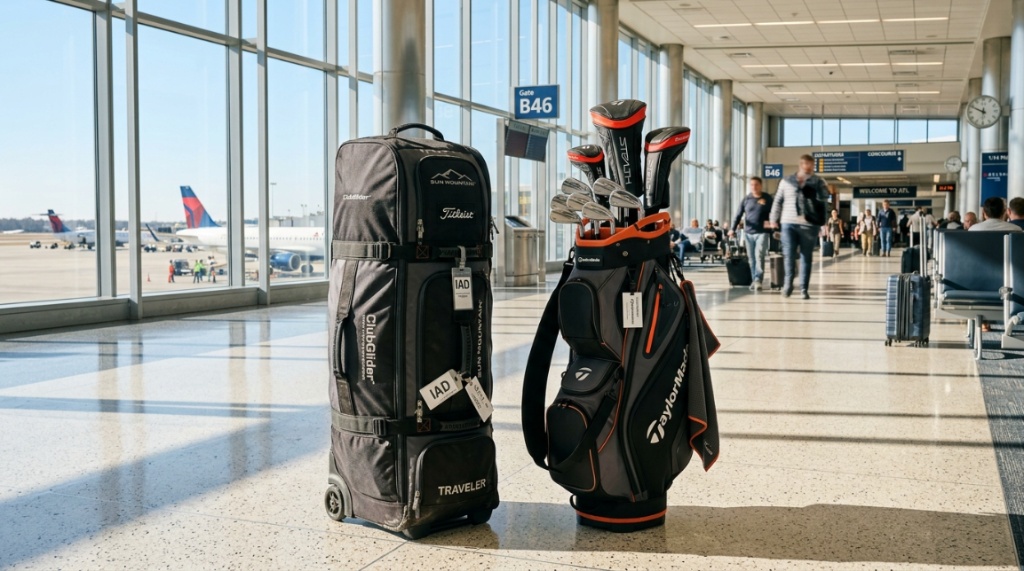
No, unless you have an enormous staff bag. The larger the bag, the higher the chance it gets flagged for “oversized” dimensions, triggering additional baggage fees (usually $50-$150 each way). A standard heavy-duty travel bag fits the maximum airline dimensions of 80 linear inches (L+W+H). If you buy a massive “gladiator” size bag, you might be slapped with freight fees.
Airline Size Regulations: Staying Under the Limit
Before purchasing, measure the bag’s total dimensions. Most airlines consider anything under 62 linear inches to be standard, but golf clubs are an exception. The sweet spot is a bag that is 50-52 inches tall, 14-16 inches wide, and 12-14 inches deep. Always check the specific airline’s policy for “sporting equipment” as they often have negotiated rates that differ from standard oversized luggage.
The Hidden Cost of “Free” Shipping on Large Bags
When buying online, “free shipping” is only sometimes a bargain. Because these bags are bulky, retailers often use FedEx Ground, which can take 5-7 days. More importantly, return shipping is usually not free. If the bag arrives damaged, you might have to pay $40-$60 to ship it back. Try to buy locally in Georgia if possible to avoid this headache.
How Do I Pack My Clubs to Maximize Safety Inside the Travel Bag?
Packing correctly is just as important as the bag itself. Even the toughest bag will fail if your clubs are thrown around inside. You need to lock the clubheads together and prevent the shafts from hitting the sides of the case.
Using a Stiff Arm: The “Secrets” to Proper Installation
Place the stiff arm into the top of your golf bag, sliding it down until it rests on the plastic tube at the bottom. It should extend 2-3 inches above the driver headcover. Tighten the knob until it presses firmly against the cover. This creates a “roof” that takes the impact instead of your driver,While a heavy-duty bag protects your clubs from airline impact, don’t forget to pack reliable waterproof golf clothing for ultimate protection to keep yourself dry during unexpected course downpours.
Wrapping the Clubheads with Towels
Even with a stiff arm, wrap a large bath towel around the clubheads and snap the hood over the driver. This prevents the metal clubs from banging against each other. For wood heads, use their individual headcovers. Do not leave iron covers on; they trap moisture and cause rust, but do wrap the iron heads with a towel.
Valuables Check: Never Pack Electronics or Liquids
The travel bag is for golf gear. Even though the bag is heavy-duty, the interior is not pressurized, and impacts can damage a Rangefinder or a flashlight. Always carry your valuables in your carry-on. Also, ensure your liquids (sunscreen, bug spray) are tightly sealed in a Ziploc bag inside the side pocket to prevent leakage onto your grip.
What Maintenance Does a Heavy-Duty Bag Require?
These bags are workhorses, but they need basic care to extend their life. After a trip, you should wipe down the wheels and base to remove dirt and gravel that can abrade the fabric over time. If you used the bag in the rain, air it out with all zippers open to prevent mold.
Cleaning the Ballistic Nylon and Plastic Shells
For nylon, use a mild soap and water solution with a soft brush. Avoid using a pressure washer, which can force water through the seams. For plastic shells, use a plastic cleaner (like mother’s back-to-black) to remove scuffs and keep the UV protectants active, preventing the shell from becoming brittle.
Lubricating and Replacing Zippers
Do not use petroleum jelly on zippers; it attracts dirt. Use a silicone-based lubricant spray (like Tri-Flow) on the zipper teeth to keep them gliding smoothly. If a zipper pull breaks, you can easily replace just the pull with a luggage keyring, meaning you don’t have to buy a new bag.
When Is the Right Time to Replace Your Travel Bag?
If you are asking this question, the answer is usually “now.” If you see cracks in the ABS shell, tears in the nylon, or if the wheels are wobbly, the bag has compromised structural integrity. Retiring a bag before it fails is smarter than having it disintegrate at customs.
Signs of Hidden Damage
Look for stress marks on the handle grips (white lines on plastic), and check the internal straps for fraying. If the bag tilts to one side when rolling, the base is likely bent. A compromised bag will not absorb impact properly, and you risk injury to your clubs.
Frequently Asked Questions
Is it better to get a hard case or soft case for flying?
Hard cases offer superior crush protection but are heavier and harder to store. Soft cases are lighter and easier to store but require a stiff arm and more careful packing. For maximum safety, pick a hard case. For convenience, pick a high-quality soft case with a rigid top.
Can I combine my golf bag with a carry-on?
No, a golf travel bag is a standalone piece of luggage. You can bring a small carry-on as well, but the travel bag must be checked. The travel bag itself will be counted as your checked luggage.
What is the approximate cost of a decent heavy-duty travel bag?
You can expect to pay between $80 and $150 for a quality soft-sided heavy-duty bag. Hard-shell cases typically start at $150 and go up to $400. Anything cheaper than $80 is likely too flimsy for regular air travel.
Can I check my electric golf trolley in the same bag?
Generally, no. Most travel bags are too small for both a trolley battery and clubs. The battery is also a safety concern due to lithium-ion restrictions. Check your airline’s policy—most require the battery to be removed and carried on.
Will a travel bag fit in an Uber or taxi?
Yes, most full-size travel bags will fit into a standard sedan’s trunk or an Uber XL. However, they are long, so if you’re in a compact car, you may need to fold down a back seat to accommodate the bag length.
Do airlines offer bubble wrap for clubs?
No, airlines do not offer wrapping services. You must provide your own stiff arm, towels, and protective packing materials. Some smaller FBOs at private terminals might, but commercial airlines will not.